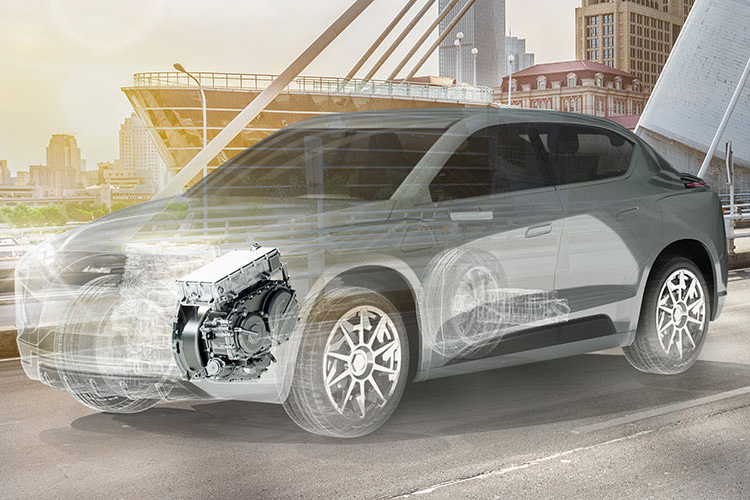
Modern vehicles must manage crash energy in increasingly complex ways—especially as battery electric vehicles (BEVs) reshape what’s possible in vehicle packaging and structure. Traditional vehicle front-end architectures were largely designed around the space, mass, and constraints of internal combustion engines (ICE), influencing how forces moved through the structure during an impact.
As OEMs continue to advance and refine BEV programs, there’s an opportunity to rethink front-end design from the ground up and improve how crash energy is managed before it reaches the passenger cabin.
In simple terms, Magna’s two‑load‑path front‑end architecture is designed to redirect crash energy outward and away from the cabin, helping improve occupant protection while supporting BEV structural requirements. Developed to be compatible across multiple vehicle platforms, the architecture also addresses priorities such as battery protection, weight reduction, and design scalability—without compromising crash performance.
Crash Safety and Performance, Reimagined
Because BEVs don’t require traditional ICE based structures for motor packaging, engineers have greater flexibility in how vehicle structures are designed to manage impact forces. Magna’s goal wasn’t simply to create a BEV friendly front end, but to address longstanding limitations in how many traditional architectures distribute crash energy.
In most conventional designs, impact forces can travel rapidly backward through the vehicle structure. Magna’s approach instead focuses on re routing those forces outward, strategically managing energy paths to reduce intrusion risks and better protect occupants.
By reengineering the primary load path and relocating it to the vehicle sill level, Magna engineers achieved a more efficient and controlled distribution of crash loads. The design leverages angled, forward converging longitudinal structural components and integrates core subframe and suspension functions earlier in the build process, such as during the body in white stage.
Developing the structure required extensive optimization work, including topology optimization and finite element analysis, to arrive at a configuration capable of meeting demanding crash requirements.
In virtual testing, Magna’s architecture met—and in certain key cases exceeded—targets in two challenging crash scenarios:
- Pole crash performance – Traditional designs rely on bending beams and complex reinforcements to manage pole crashes. The new concept uses direct load paths from the impactor to the sills, significantly improving energy absorption efficiency. During testing, the architecture reduced pole intrusion by up to 60% versus a conventional baseline. Depending on OEM design priorities, the same load-path strategy can also be tuned to maintain comparable crash performance while reducing weight and part count.
- Offset Deformable Barrier (ODB) performance – Conventional vehicles aim to absorb the full kinetic energy of the crash. In contrast, the new architecture introduces a controlled deflection strategy, allowing the vehicle to glide laterally along the barrier. During testing, this reduced peak loads in longitudinal direction and distributed forces more evenly across the structure, which lowers occupant injury risk as well as battery protection by reducing intrusions in critical areas (IIHS-criteria) by 50%.
Together, these results demonstrate how a redesigned load-path strategy can improve crash energy management and help support safer, more resilient vehicle structures.
Beyond Crash Energy Management
Improved crash performance is the primary goal, but the architecture is designed to deliver value beyond occupant safety.
By integrating key functions and supporting modularity, the structure can help enable:
- Parts reduction, helping lower system complexity
- Manufacturing efficiencies through simplified assemblies and integration points
- Improved battery protection by supporting structural strategies that help shield the pack during crash events
- Weight reduction, positively influencing vehicle efficiency and range
- Environmental benefits through reduced mass and potential material/process efficiencies
These benefits matter because BEV programs place unique pressure on structures to do more at once—protect the battery, manage higher mass, support range targets, and scale across multiple vehicle architectures
A Scalable Path for BEV Platforms
Magna’s two-load-path front-end architecture is designed to be implemented across multiple vehicle platforms, supporting OEM flexibility as product portfolios evolve. As BEV architectures become more varied—and update cycles accelerate—structural solutions that balance safety, integration, and scalability can help OEMs move faster without compromising performance.
This innovation reflects a broader shift in crash safety: it’s no longer about stronger structures, but about smarter energy management, engineered into the architecture from the start.
To learn more about Magna’s body‑in‑white and crash energy management capabilities, visit www.magna.com/products/body-chassis/body-in-white-solutions.